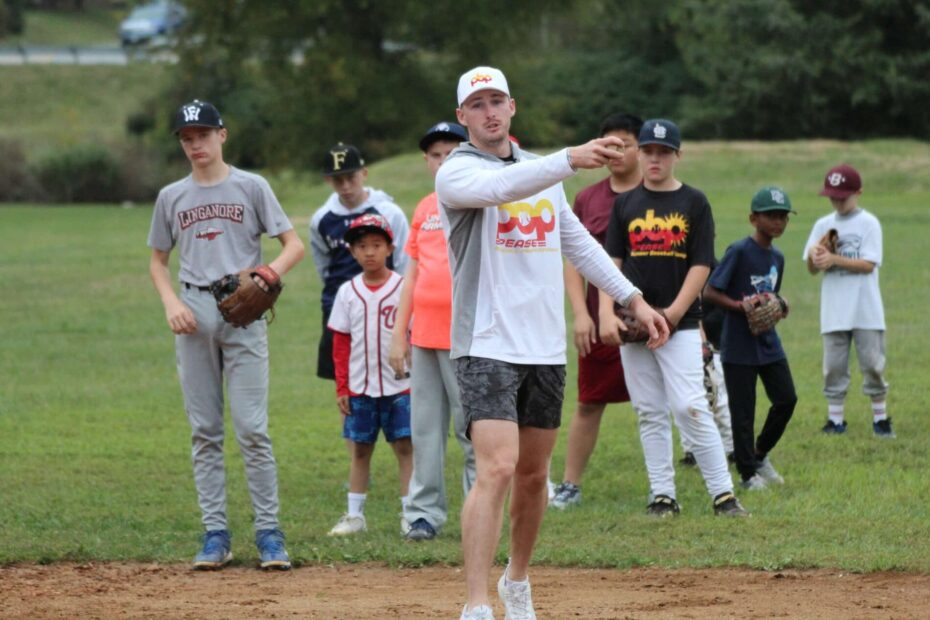
Wise Words by Kevin Wilson

We start playing the game of baseball because we enjoy it and have fun playing with our friends. 

Then after a few years, the fun starts to fade and is replaced with the overly-competitive amateur baseball scene which promotes a rat-race mentality to attain a college scholarship and/or announce to the world via social media that we have verbally committed to college as an 8th grader (I’ll reserve my comments on verbal commitments).

Then a few years later, we focus our attention on wanting to get drafted out of high school. 

Then when we get drafted, we want to get to the big leagues. When we get to the big leagues, we want to play every day. Then when we play every day, we want to sign a big contract. Then when we make more money, we want to be in the Hall of Fame. Then when we are in the Hall of Fame….

Where does it end? 

What Do You Want?

It’s one of the most important questions we can ask ourselves. I’ll tell you what you want – you want your way, you want to do what you want to do, and you want what you want, now. 

Every stage of your life requires a better version of yourself. You will answer the question of “what do I want?” differently when you’re 15, compared to when you’re 25, 35, 45, or 55. The younger you are the more what there is. The older you get there is less what – but there is always something that you want. Everybody wants something as they get older, but it becomes less of a thing (i.e. fancy car, bigger house, more money, etc) and more of a value (time with family, enjoying a long walk, having your health, giving back to your community, etc). 

In every season of your life you will answer this question a little differently. 

As long as you insist on having your way, you won’t get what you really want. 

For example, if you started playing the game of baseball for the pleasure of playing the game with your friends, over time you realize that too much a good thing can lose its pleasure. Pleasure is addictive. It can control you. And you quickly discover that what started out as a pastime, was actually a pathway to something that controls you.

And then you wish that you never got the thing that you wanted – the college scholarship, the opportunity to play professional baseball, etc.

This is why “What do you want?” is such a tricky question.

The Value of Time

What we want now isn’t always what we want later. 

We want the base hit now. We want to sign with a college now. We want to get the call-up to the big leagues now. 

What we want today often ends up in the way of what we want tomorrow. 

Think about it this way. What we bought on the credit card when we were younger, isn’t what we are wearing now. What we financed then, isn’t what we are driving now. The high school sweetheart we thought we were in love with, isn’t the person we married. 

Regret is having what you want but realizing you’re in possession of something that is of no value in your life. Regret is the elimination of options. It’s the inability to go back to get what you really want because you got what you wanted. 

Here is the problem though. 

If we always get our way, we lose our way. If we always get our way, we get in our own way. In other words, you got your chance in the big leagues, but you burned a lot of bridges, sacrificed relationships and cut corners to get there. When you arrived, you realized that it’s not the experience you dreamed of because you changed as a person and instead of being happy about where you got to, you’re miserable and wishing that you could go back in time to when it was just a game – or quit altogether. 

Why? 

Because every step of your journey had lost all of the value it was meant to provide. You never get what you want until you discover what is most valuable.

And if we always do what we want to do, we end up in a place that we don’t necessarily want to be in. And if we always get what we want now, it may keep us from getting what we ultimately want later.

In other words, you had what you wanted but as a result, you don’t have what you want because you got what you wanted, which isn’t ultimately what you want.

How many people choose what’s desirable over something that has lasting impacts? 

Make sure what you want today, reflects the value of what you still want tomorrow.   

Love,

KW

For more than 20 years, Kevin Wilson has been one of the most respected hitting coaches in the game. He works behind the scenes as a private hitting mentor to some of the best hitters and coaches in Major League Baseball. In 2013, Kevin was the hitting coach for the USA Baseball 18U National Team. Team USA beat Japan for the Gold medal at the IBAF World Cup in Taichung, Taiwan.

Follow Kevin at  @KWBaseball and visit his website KWBaseball.com

A huge thank you to Kevin Wilson for taking the time to pour into our PBP community with this piece. Kevin and I go way back—first crossing paths during my own playing career, then reconnecting and strengthening our relationship through years of conversations on Twitter, where we constantly hammered home the real fundamentals of pitching, hitting, skill acquisition, and what it truly means to develop talent with purpose.

Kevin has traveled the world impacting hitters at every level, and he’s always done it with intention, humility, and a genuine desire to make the game better. I’ve respected his work for a long time, and I’m grateful for the friendship, the shared curiosity, and the countless rabbit holes we’ve gone down together trying to push player development forward.

Kevin, thank you for continuing to invest in the baseball world and for lending your voice to our community here at PBP. I appreciate you, brother. — Dustin Pease

Bryson Shaffer – PBP Journey Series

••• Read More

I’ve known Bryce what seems like forever ago. He came to me as this young and excited player, eager to learn and become a better pitcher. We hit if off right away, became very close with the entire family, and our lesson meetings were very consistent. This was back when I had just moved into Frederick from Baltimore, and was slowly meeting new players out this way. Bryce was constantly asking me about my playing career, and how I was able to make it so far. He saw my size and build and wanted to soak up as much knowledge as possible to give him that edge to be an elite competitor. He knew I was a sidearmer, and eventually he came to me one day and said, “I want to pitch EXACTLY like you”… I was unsure how to respond in the moment, because as a pitching coach you don’t just teach people to pitch identically to yourself, the goals are to help each player find their authentic movements and patterns that work for them. Bryce wasn’t having it, he wanted to learn to pitch JUST LIKE ME, there was no talking him out of it. It was truly humbling, and after some time we dove into it full steam ahead, before long his delivery looked unmistakable from my own, from the leg kick, to the arm slot, deception, cross-fire, pick-off move, mound presence, pitch shapes / breaks, he became a true protege and it was fun to watch unfold over the days, weeks, months, and years. I cannot even begin to describe the type of drive, persistence, work ethic, grit, and overall joy Bryce possessed in his training and developmental years. Everyday was fun for him to practice, and he reaped the rewards over and over again. He carried a lot of weight throughout his college experience, and was able to overcome big challenges early on, and he is now thriving in the Tampa Bay Rays organization. He is part of an amazingly supportive family, and I’m forever thankful to have been given the opportunity to train Bryce for so long, and be a part of his life and baseball journey, and we will always stay connected. It goes without saying that I’m extremely proud of all of what he has accomplished, and it is a true testament to his own work ethic and drive, which will carry him far in life beyond the game. We’ve both learned a lot about each other over the years, and I’m super thankful he was willing to share his experience as part of this series, and kick it off as the first one! — Dustin Pease

    •    Full Name: Bryson Shaffer

    •    Age: 24

    •    Current Professional Team/Organization: Tampa Bay Rays

    •    Position(s): LHP

    •    College: Coastal Carolina University

    •    High School & Hometown: Brunswick HS, SJCP, Island Coast High Cape Coral

Island coast high school Cap Coral

I would say when I started taking lessons with Dustin when I was 14

So this is where the story gets crazy…

I started at Brunswick High School in 2016. I played three years there, then transferred to St. John’s Catholic Prep my junior year in 2018 to reclassify and get bigger and stronger for baseball. Because of that, I technically had another junior year — but I had to sit out, because you only get four eligible playing years.

After that, my family and I decided to move to Florida so I could keep chasing baseball. I finished high school and baseball down there in 2020. Sadly, that was the COVID year, so we didn’t have a full season. I put up good numbers, but nobody wanted me. I had one shot to go play at a JUCO, and I had to try to earn a scholarship. Money was tight, so I didn’t have much room for options.

So I went to Polk State. And honestly, it was the worst experience of my life. It was hell. Everything that could go wrong, went wrong. That was the moment where everything changed. I went to my dad and told him, “Baseball isn’t for me.” Saying that to the one person who always believed in me hurt the most. All he ever wanted to do was help.

He told me, “Just give it one more try. One more year of work.”

So I did.

I called a college I had played against — South Florida State College. They said they had a spot, but no scholarship money left. My dad said, “Just go.” So I went. And I told him I would prove to him that I wasn’t good enough.

So I worked. I worked out twice a day. I ran miles before and after practice. I was basically David Goggins. The part people misunderstand about JUCO is they think it’s all discipline on your own. But really, the only extra thing I chose to do was that second workout every morning and night. Everything else was required. That JUCO saved me — but at the time, I was convinced I was proving to my dad that I didn’t have it.

I became the first in every mile run. The first to show up to lift and the last to leave. I ate more than anyone to gain weight. I became a machine. I got stronger, bigger, faster. I went from 86 mph to 94 mph in one fall.

My coach pulled me into his office and said, “Bryce, we have a full scholarship for you — and you’re starting our opening day game.”

I called my dad instantly. He just said, “I told you.”

I kept going and put up great numbers. Then I got my first call from Coastal Carolina — 85% scholarship. I’ll never forget sitting there with my dad and the coach on speaker. My dad started crying. I said yes immediately. I came from a place where barely anyone believed in me except my dad, Dustin, and the few coaches who gave me a chance just to throw.

The next week, my coach pulled me back into his office and turned his computer screen toward me. Every Division I school in Florida was interested. He never told me. And I don’t regret my decision — because it showed me something:

You have to work. You have to work like you have something to prove.

My work ethic never changed after that. I’ll always feel like I have someone to prove wrong, and something more I can become.

After two years at Coastal Carolina — and turning down the Pirates in 2024 — I chose the Tampa Bay Rays the following year.

And I’ve loved it ever since.

I’d say one of the biggest turning points for me was not making varsity in high school — at least not at first. I only got brought up when they needed someone, and they basically just threw me in. Once they saw I could pitch, I became the starter. I went from someone nobody relied on… to someone the coaches couldn’t not play.

My best achievements have always come from working in silence and letting the work speak for me. The accomplishments and awards come and go — but I’m nowhere near where I want to be yet.

I’d say one of the hardest parts was making the right decisions. A lot of the time my buddies wanted to go out, party, or do things I knew would pull me away from what I wanted. Choosing to be a baseball player — and actually living like one — was the challenge. And honestly, it’s still hard sometimes.

Another big thing was always getting teased for not being good enough. I just kept my head down and worked. And eventually, I outperformed everyone.

Like I said before, I was always the last pick — the last guy for everything. So again, I got stuck in the Complex League, which is basically just extended spring training. When they posted the roster, I took a picture of the list. I was the only healthy arm from my draft class that got held back. I made that picture my phone wallpaper so I had to look at it every day.

And I just kept working.

Eventually, I got my shot to go to Low-A — and I became one of their best arms, finishing the season with almost 50 innings out of the pen.

The routine changes depending on the level and workload. For example, when I was in Low-A last year, a typical day looked like this:

I’d wake up around 10, grab something to eat, and hang out with my roommate for a bit. Then I’d head to the field around 1 to get a light lift in. After that, I’d eat lunch or some snacks at the field, then head out to stretch and play catch.

Once that was done, I’d go to the training room — get cupping or scraped — then hit the hot tub and cold tub while waiting for the game. Usually I’d watch some golf videos to kill time. By then, it was time to get ready and head out for the game.

In pro ball, they don’t practice during the season — so you have to do your work on your own.

I want to be the best. I want to keep climbing the affiliates and being in the Big Leagues soon. I’m not stopping or never going to stop trying.

Without him none of my dreams would have came true I know this 100%

He doesn’t just teach mechanics. Baseball is 80% mental it’s how he explains why we’re doing it and what’s the importance to it. At a young age he was smart to explain location is the most important thing IT IS. I believed that and continued to throw 60 mph in high school as their best starter because I did this.

If you really want to be a professional, go to PBP. Talk to Dustin. Listen to my story — I didn’t have much, but I worked, I believed in myself, and I stayed with it until it became real.

If you take anything away from PBP, it’s this: everyone there has the same dream. And at the end of the day, you need to surround yourself with dogs — people who are chasing it just like you.

FEATURE:

Bryce Shaffer is a left-handed pitcher whose career has been defined by steady growth and resilience. Beginning at Polk State College out of high school, Shaffer experienced early adversity before transferring to South Florida State College, where he made a significant developmental jump. There, he added strength, improved his delivery, and made a notable velocity climb that positioned him as a legitimate next-level arm. That progression led him to Coastal Carolina University, where he stepped into a nationally respected Division I program and proved he could compete against high-level talent. At Coastal, Shaffer established himself as a reliable bullpen option, known for competing in the zone, handling pressure situations, and maintaining a consistent presence on the mound.

Following his time at Coastal, Shaffer signed professionally and began his career in the Tampa Bay Rays organization. He opened in the Complex League, then earned his way onto the Charleston RiverDogs (Single-A) roster. During his season in Charleston, Shaffer appeared in relief and delivered a strong year, posting a 3.29 ERA with 43 strikeouts in 41.0 innings, while maintaining a 1.41 WHIP. His ability to control innings, generate swing-and-miss when needed, and handle the workload across a full professional schedule helped establish him as a trusted bullpen arm in the system and should continue to make his way up the ranks!

Shaffer’s path is one marked by development rather than shortcuts — moving from under-recruited and overlooked roles to becoming a contributor at the Division I and professional levels. His continued trajectory reflects a pitcher who understands how to adapt, compete, and grow inside the game.

Brett - Infield Lessons

Learning Infielding the Right Way with Brett Ahalt

At Pease Baseball, I’m always looking for ways to bring our community closer to the game and the people who know it best. Recently, we had the opportunity to host a free infielding clinic with one of our coaches, Brett Ahalt. Brett has an incredible baseball background — a standout collegiate infielder and now one of the sharpest coaches I’ve been around.

We captured the session on video so you can go back, watch, and learn right alongside our players:
👉 Watch the full infielding clinic with Brett Ahalt


What I Love About Brett’s Approach

As I watched Brett run this clinic, a few things stood out to me right away:

  • The Ready Position & Footwork – Brett emphasizes starting from a balanced, athletic base. You can’t make plays consistently unless your feet and body are in sync, and I couldn’t agree more.
  • Glove Work with Soft Hands – His focus on keeping the glove low, soft, and active with the bare hand is exactly how we teach infield play here. It’s such a small detail, but it’s the difference between routine outs and frustrating errors.
  • Angles and Momentum – Brett shows how great infielders don’t just stop the ball — they move through it with intent, creating momentum toward their throw. This is something we work on constantly with our players at Pease Baseball.
  • Smooth Transitions – Watching him demonstrate how to gather and throw in one fluid motion, I couldn’t help but think: these are the habits that separate good infielders from elite ones.

Why This Matters for Our Players

At Pease Baseball, my goal has always been to give players access to the kind of knowledge and detail that I wish I had growing up. Clinics like this aren’t just about drills — they’re about building a foundation that allows players to play freely and with confidence.

When you train here, we don’t just repeat reps for the sake of reps. We break down movements, record and review your mechanics, and put you in game-like scenarios so the skills stick when it matters most. What Brett demonstrated in this clinic is exactly the kind of teaching environment we provide every day inside our facility.


Final Thought

I’m proud to have coaches like Brett on our team. The way he communicates the game, the detail he brings, and the energy he gives players is something I value deeply — and I know our athletes benefit from it.

If you haven’t already, take some time to watch the clinic. Even better, come work with us directly. Whether you’re an infielder looking to tighten up your fundamentals or just starting to build confidence in your game, Pease Baseball is here to guide you.

👉 Schedule a lesson or learn more about training with us

— Dustin Pease
Founder, Pease Baseball Professionals

Trackman

At Pease Baseball Professionals (PBP), we have a new, exciting program to roll out this year that will bring the absolute best player development experience to the local baseball community here in Frederick, MD, as well as the surrounding states, from which we draw talent who find value in the quality of instruction we provide at PBP. 


After ample contemplation, in the upcoming weeks we plan to invest in a Trackman system, which will tremendously enhance our player development model. Trackman technology has become the industry leader in data tracking for professional and collegiate baseball (Any data or information you see on MLB TV broadcasts and MLB online statcast data is all provided by Trackman). Professional and NCAA collegiate programs hold Trackman data in high regard within their respective recruiting/scouting departments. This system, however, utilized in every MLB stadium across the country, comes at a very steep price, especially the Trackman model we will be purchasing that assesses both pitchers AND hitters. Therefore, we are looking for players interested in investing in their progress over time. 

Many of you may be asking, what does Trackman actually do? To say the least—EVERYTHING. It tracks every single metric available for hitters and pitchers in terms of player physical movement/positioning (hitting/swing and pitching/throw mechanics) all the way to baseball trajectories, locations, spin, axis, ball flight, distance, 3D contact points, and velocity. There are more intricate pieces of data it produces and our assessment process in translating this data is what will impact player development and performance over time. Access to this information is invaluable to our development team here at PBP in terms of optimizing a blueprint of development and tracking progress. Our expertise will make this immense amount of data easier to understand, digestible, and transferable to improving our players.  

Having your own personal access to this information to share with recruiters in this day and age is an invaluable asset in addition to the vast amounts of assistance it provides in developing player skill and performance. We will also be offering ‘showcase videos’ where we can attach the data to it, giving recruiters / scouts a deeper look of a players ability.  This opportunity will be available to players of all ages to begin tracking and recording progress over time. Below are available options for subscribing to Trackman technology at PBP. 

Learn more about the subscription model.

Upcoming Events